You have 3 items in your cart

Sub Total :$63.66

It’s commonly thought that a traditional residential solar system will continue to provide uninterrupted service and produce electricity during grid interruptions. After all, shouldn’t the system still function if the sun is shining and the grid goes out?
Historically, residential solar was originally intended to cease operation in the event of a grid failure. This is currently changing as energy storage devices, solar power, and other upcoming technological advancements enhance the capacity to operate during a grid outage. So, the question remains, how do solar panels function both with and without storage when the grid is down?
Since the majority of customers have grid-tied systems in their houses, residential solar without storage is intended to shut off after a power loss. This is done mostly for safety concerns. In the past, inverters used grid electricity to deliver a constant frequency to your house. These essential pieces of machinery convert solar power’s direct current (DC) into usable alternating current (AC) for your home.
In order to get permission to connect the system to the grid, the installer must file an interconnection application to the local utility when a customer wishes to go solar. The customer’s home will always have electricity thanks to this, even at night or when there are clouds in the sky. Grid-tied systems additionally enable the solar array to feed any extra energy generated back into the grid. This extra output will be traded for a feed-in tariff credit or a net metering credit on the electricity bill. The grid is essentially acting as a storage device, but purely a monetary one, not for backup solution for grid failure. In the event of a grid outage, the system will not function.
Grid-tied systems without backup are designed to shut down to safeguard utility employees who could be repairing the wires during an outage. Safety is always the top priority.
In late 2021, Enphase released the IQ8 series of micro inverters that delivered a revolutionary promise — to provide power to your home during a grid outage with the need for a physical on-site solar battery.
By drawing electricity directly from the solar array, IQ8 systems can offer a limited and conditional home backup in the event of a utility grid failure. There are some very obvious restrictions, such as the fact that backup power is only accessible when the sun is shining (hence the name Sunlight Backup). But the IQ8s are going to be a highly enticing option for homeowners wishing to go solar given that it provides access to at least some backup power without costing a cent in batteries.
According to its marketing, the new IQ8 is “grid-agnostic,” which simply means that it can operate with or without a connection to the electric grid. The IQ8’s faster processing speeds enable it to respond in 20 nanoseconds to the addition or removal of electrical loads from the system.
That’s quick enough for your system to establish a reliable local AC microgrid and handle the output from your panels immediately. A miniature local power grid is essentially created on your property by the system, eliminating the need to send electricity to the utility grid for DC to AC conversion.
Again, there is a very stringent restriction attached to this: your backup level is reliant on the available sun to produce the electricity for real-time power. You won’t have any backup power at all at night. You’ll only have a little quantity of backup power available during dawn and twilight because solar irradiation is lower. The graphs from Enphase’s IQ8 demo presentation below provide a clear explanation of the idea.

The Sunlight Backup potential will be at its best on fully sunny days. The amount of accessible backup power decreases over the winter as the amount of sunlight diminishes.
The same is true for days with clouds, when backup capacities change as clouds pass overhead.
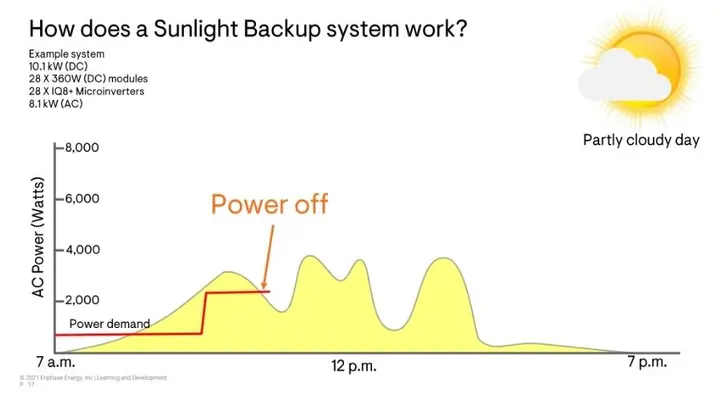
• During a power outage, if you attempt to use more electricity than your array is generating, your Sunlight Backup system will trip and momentarily turn off. In this scenario, the IQ System Controller will make many reboot attempts throughout the day.
• No one load should consume more than 30% of the power of your solar array, according to Enphase’s recommendation.
• Sunlight Backup mode must be enabled with an IQ Combiner. Even though this component is more expensive, it is still much less expensive than adding a battery bank. Both the IQ7s and IQ8s are excellent grid-tie solar options if Sunlight Backup is not a concern for you.
Having a battery storage system helps ensure that your solar system keeps running even if there is a power outage. These energy storage systems store solar-generated energy for later use. The combined solar + storage device cuts itself off from the grid during a power loss and promptly resumes supplying power to the house, giving you the uninterrupted electrical service you require in emergency situations.
The storage unit size must be carefully chosen, just as solar system sizing is important. Your solar battery backup can be sized to serve your most important energy needs or it can be sized larger to handle even more appliances during a grid outage, depending on the energy profile of your home. When deciding between solar without backup and solar with battery backup, you will want to consider your goals, regional incentives, electricity costs, and peak demand fees from your utility company. To discuss the specifics of your case, we advise scheduling a meeting with one of our Energy Consultants in your area.
Interested in learning about the two most reputable batteries on the market? Checkout our match-up between the Enphase IQ 10 and Tesla Powerwall 2.
Switch to solar energy in Virginia with Solar Ignite Group, where you can take advantage of a number of significant benefits, including savings, dependability, backup solutions for grid outages, renewable energy, increased property value, and much more, all with no heavy lifting responsibility on your end.
Discover how you can take control of your residential power with zero up-front
out-of-pocket expenses and save big.